With the change, we remove the special casing of workspace dependencies
and resolve `tool.uv` for all git and directory distributions. This
gives us support for non-editable workspace dependencies and path
dependencies in other workspaces. It removes a lot of special casing
around workspaces. These changes are the groundwork for supporting
`tool.uv` with dynamic metadata.

The basis for this change is moving `Requirement` from
`distribution-types` to `pypi-types` and the lowering logic from
`uv-requirements` to `uv-distribution`. This changes should be split out
in separate PRs.

I've included an example workspace `albatross-root-workspace2` where
`bird-feeder` depends on `a` from another workspace `ab`. There's a
bunch of failing tests and regressed error messages that still need
fixing. It does fix the audited package count for the workspace tests.
## Summary

I haven't tested on Windows yet, but the idea here is that we should use
a portable representation when printing paths.

I decided to limit the scope here to paths that we write to output
files.

Closes https://github.com/astral-sh/uv/issues/3800.
## Summary

This is universal environment variable used to determine the mac OS
deployment target. We now respect it in `--python-platform` -- so we
default to 12.0, but users can override it as needed.
## Introduction
PEP 621 is limited. Specifically, it lacks
* Relative path support
* Editable support
* Workspace support
* Index pinning or any sort of index specification
The semantics of urls are a custom extension, PEP 440 does not specify
how to use git references or subdirectories, instead pip has a custom
stringly format. We need to somehow support these while still stying
compatible with PEP 621.
## `tool.uv.source`
Drawing inspiration from cargo, poetry and rye, we add `tool.uv.sources`
or (for now stub only) `tool.uv.workspace`:
```toml
[project]
name = "albatross"
version = "0.1.0"
dependencies = [
"tqdm >=4.66.2,<5",
"torch ==2.2.2",
"transformers[torch] >=4.39.3,<5",
"importlib_metadata >=7.1.0,<8; python_version < '3.10'",
"mollymawk ==0.1.0"
]
[tool.uv.sources]
tqdm = { git = "https://github.com/tqdm/tqdm", rev = "cc372d09dcd5a5eabdc6ed4cf365bdb0be004d44" }
importlib_metadata = { url = "https://github.com/python/importlib_metadata/archive/refs/tags/v7.1.0.zip" }
torch = { index = "torch-cu118" }
mollymawk = { workspace = true }
[tool.uv.workspace]
include = [
"packages/mollymawk"
]
[tool.uv.indexes]
torch-cu118 = "https://download.pytorch.org/whl/cu118"
```
See `docs/specifying_dependencies.md` for a detailed explanation of the
format. The basic gist is that `project.dependencies` is what ends up on
pypi, while `tool.uv.sources` are your non-published additions. We do
support the full range or PEP 508, we just hide it in the docs and
prefer the exploded table for easier readability and less confusing with
actual url parts.
This format should eventually be able to subsume requirements.txt's
current use cases. While we will continue to support the legacy `uv pip`
interface, this is a piece of the uv's own top level interface. Together
with `uv run` and a lockfile format, you should only need to write
`pyproject.toml` and do `uv run`, which generates/uses/updates your
lockfile behind the scenes, no more pip-style requirements involved. It
also lays the groundwork for implementing index pinning.
## Changes
This PR implements:
* Reading and lowering `project.dependencies`,
`project.optional-dependencies` and `tool.uv.sources` into a new
requirements format, including:
* Git dependencies
* Url dependencies
* Path dependencies, including relative and editable
* `pip install` integration
* Error reporting for invalid `tool.uv.sources`
* Json schema integration (works in pycharm, see below)
* Draft user-level docs (see `docs/specifying_dependencies.md`)
It does not implement:
* No `pip compile` testing, deprioritizing towards our own lockfile
* Index pinning (stub definitions only)
* Development dependencies
* Workspace support (stub definitions only)
* Overrides in pyproject.toml
* Patching/replacing dependencies
One technically breaking change is that we now require user provided
pyproject.toml to be valid wrt to PEP 621. Included files still fall
back to PEP 517. That means `pip install -r requirements.txt` requires
it to be valid while `pip install -r requirements.txt` with `-e .` as
content falls back to PEP 517 as before.
## Implementation
The `pep508` requirement is replaced by a new `UvRequirement` (name up
for bikeshedding, not particularly attached to the uv prefix). The still
existing `pep508_rs::Requirement` type is a url format copied from pip's
requirements.txt and doesn't appropriately capture all features we
want/need to support. The bulk of the diff is changing the requirement
type throughout the codebase.
We still use `VerbatimUrl` in many places, where we would expect a
parsed/decomposed url type, specifically:
* Reading core metadata except top level pyproject.toml files, we fail a
step later instead if the url isn't supported.
* Allowed `Urls`.
* `PackageId` with a custom `CanonicalUrl` comparison, instead of
canonicalizing urls eagerly.
* `PubGrubPackage`: We eventually convert the `VerbatimUrl` back to a
`Dist` (`Dist::from_url`), instead of remembering the url.
* Source dist types: We use verbatim url even though we know and require
that these are supported urls we can and have parsed.
I tried to make improve the situation be replacing `VerbatimUrl`, but
these changes would require massive invasive changes (see e.g.
https://github.com/astral-sh/uv/pull/3253). A main problem is the ref
`VersionOrUrl` and applying overrides, which assume the same
requirement/url type everywhere. In its current form, this PR increases
this tech debt.
I've tried to split off PRs and commits, but the main refactoring is
still a single monolith commit to make it compile and the tests pass.
## Demo
Adding
https://gist.githubusercontent.com/konstin/68f3e5ea5e8f1a30a0c9096ae72925c1/raw/d1ae3b85d5a0f3c4bb562c7dfd38c3dafc04ec08/pyproject.json
as json schema (v7) to pycharm for `pyproject.toml`, you can try the IDE
support already:
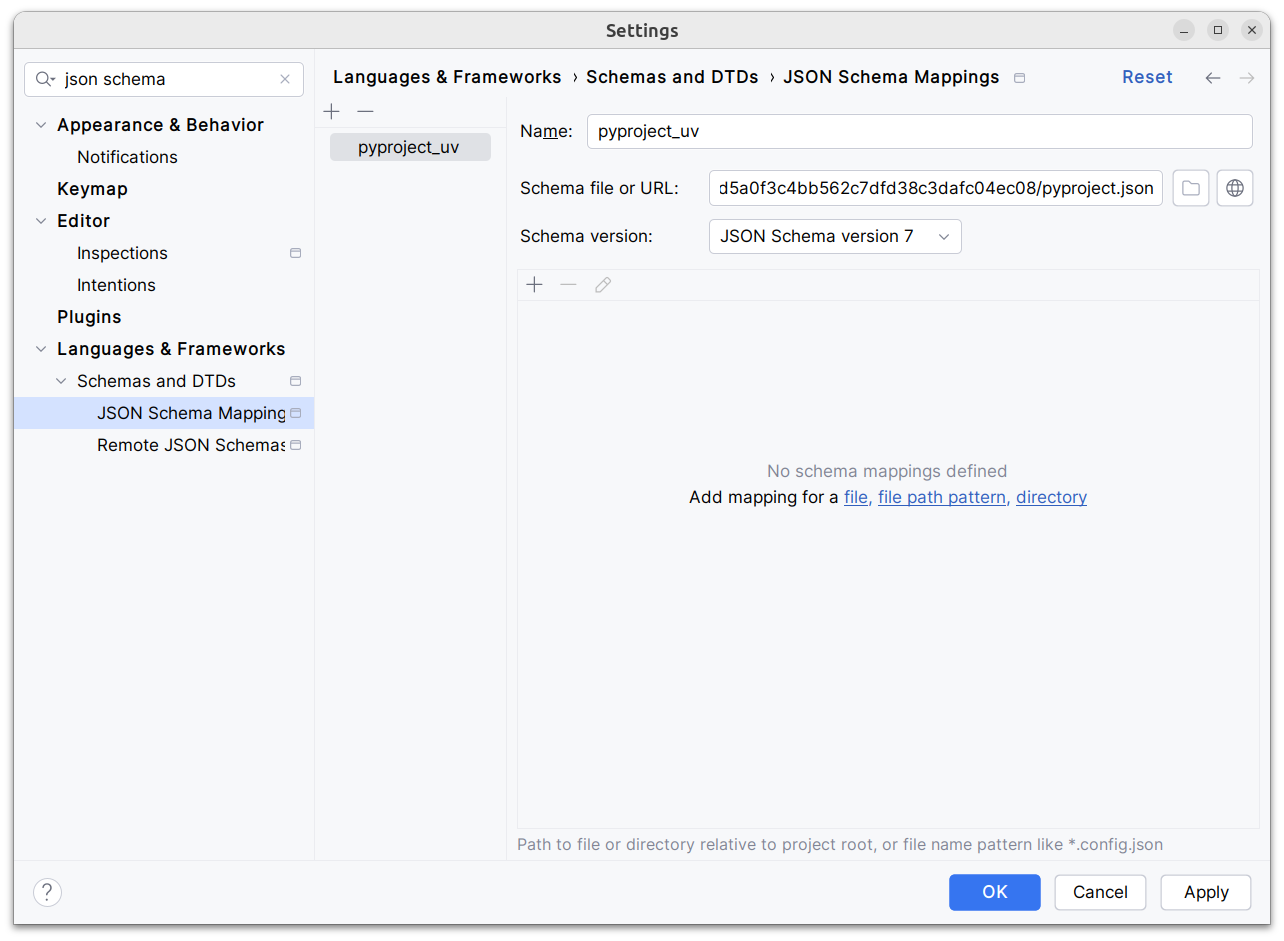
[dove.webm](https://github.com/astral-sh/uv/assets/6826232/c293c272-c80b-459d-8c95-8c46a8d198a1)
In *some* places in our crates, `serde` (and `rkyv`) are optional
dependencies. I believe this was done out of reasons of "good sense,"
that is, it follows a Rust ecosystem pattern where serde integration
tends to be an opt-in crate feature. (And similarly for `rkyv`.)

However, ultimately, `uv` itself requires `serde` and `rkyv` to
function. Since our crates are strictly internal, there are limited
consumers for our crates without `serde` (and `rkyv`) enabled. I think
one possibility is that optional `serde` (and `rkyv`) integration means
that someone can do this:

    cargo test -p pep440_rs

And this will run tests _without_ `serde` or `rkyv` enabled. That in
turn could lead to faster iteration time by reducing compile times. But,
I'm not sure this is worth supporting. The iterative compilation times
of
individual crates are probably fast enough in debug mode, even with
`serde` and `rkyv` enabled. Namely, `serde` and `rkyv` themselves
shouldn't need to be re-compiled in most cases. On `main`:

```
from-scratch: `cargo test -p pep440_rs --lib` 0.685
incremental: `cargo test -p pep440_rs --lib` 0.278s
from-scratch: `cargo test -p pep440_rs --features serde,rkyv --lib` 3.948s
incremental: `cargo test -p pep440_rs --features serde,rkyv --lib` 0.321s
```

So while a from-scratch build does take significantly longer, an
incremental build is about the same.

The benefit of doing this change is two-fold:

1. It brings out crates into alignment with "reality." In particular,
   some crates were _implicitly_ relying on `serde` being enabled
   without explicitly declaring it. This technically means that our
   `Cargo.toml`s were wrong in some cases, but it is hard to observe it
   because of feature unification in a Cargo workspace.
2. We no longer need to deal with the cognitive burden of writing
   `#[cfg_attr(feature = "serde", ...)]` everywhere.
Needed to prevent circular dependencies in my toolchain work (#2931). I
think this is probably a reasonable change as we move towards persistent
configuration too?

Unfortunately `BuildIsolation` needs to be in `uv-types` to avoid
circular dependencies still. We might be able to resolve that in the
future.
 konsti