## Introduction
PEP 621 is limited. Specifically, it lacks
* Relative path support
* Editable support
* Workspace support
* Index pinning or any sort of index specification
The semantics of urls are a custom extension, PEP 440 does not specify
how to use git references or subdirectories, instead pip has a custom
stringly format. We need to somehow support these while still stying
compatible with PEP 621.
## `tool.uv.source`
Drawing inspiration from cargo, poetry and rye, we add `tool.uv.sources`
or (for now stub only) `tool.uv.workspace`:
```toml
[project]
name = "albatross"
version = "0.1.0"
dependencies = [
"tqdm >=4.66.2,<5",
"torch ==2.2.2",
"transformers[torch] >=4.39.3,<5",
"importlib_metadata >=7.1.0,<8; python_version < '3.10'",
"mollymawk ==0.1.0"
]
[tool.uv.sources]
tqdm = { git = "https://github.com/tqdm/tqdm", rev = "cc372d09dcd5a5eabdc6ed4cf365bdb0be004d44" }
importlib_metadata = { url = "https://github.com/python/importlib_metadata/archive/refs/tags/v7.1.0.zip" }
torch = { index = "torch-cu118" }
mollymawk = { workspace = true }
[tool.uv.workspace]
include = [
"packages/mollymawk"
]
[tool.uv.indexes]
torch-cu118 = "https://download.pytorch.org/whl/cu118"
```
See `docs/specifying_dependencies.md` for a detailed explanation of the
format. The basic gist is that `project.dependencies` is what ends up on
pypi, while `tool.uv.sources` are your non-published additions. We do
support the full range or PEP 508, we just hide it in the docs and
prefer the exploded table for easier readability and less confusing with
actual url parts.
This format should eventually be able to subsume requirements.txt's
current use cases. While we will continue to support the legacy `uv pip`
interface, this is a piece of the uv's own top level interface. Together
with `uv run` and a lockfile format, you should only need to write
`pyproject.toml` and do `uv run`, which generates/uses/updates your
lockfile behind the scenes, no more pip-style requirements involved. It
also lays the groundwork for implementing index pinning.
## Changes
This PR implements:
* Reading and lowering `project.dependencies`,
`project.optional-dependencies` and `tool.uv.sources` into a new
requirements format, including:
* Git dependencies
* Url dependencies
* Path dependencies, including relative and editable
* `pip install` integration
* Error reporting for invalid `tool.uv.sources`
* Json schema integration (works in pycharm, see below)
* Draft user-level docs (see `docs/specifying_dependencies.md`)
It does not implement:
* No `pip compile` testing, deprioritizing towards our own lockfile
* Index pinning (stub definitions only)
* Development dependencies
* Workspace support (stub definitions only)
* Overrides in pyproject.toml
* Patching/replacing dependencies
One technically breaking change is that we now require user provided
pyproject.toml to be valid wrt to PEP 621. Included files still fall
back to PEP 517. That means `pip install -r requirements.txt` requires
it to be valid while `pip install -r requirements.txt` with `-e .` as
content falls back to PEP 517 as before.
## Implementation
The `pep508` requirement is replaced by a new `UvRequirement` (name up
for bikeshedding, not particularly attached to the uv prefix). The still
existing `pep508_rs::Requirement` type is a url format copied from pip's
requirements.txt and doesn't appropriately capture all features we
want/need to support. The bulk of the diff is changing the requirement
type throughout the codebase.
We still use `VerbatimUrl` in many places, where we would expect a
parsed/decomposed url type, specifically:
* Reading core metadata except top level pyproject.toml files, we fail a
step later instead if the url isn't supported.
* Allowed `Urls`.
* `PackageId` with a custom `CanonicalUrl` comparison, instead of
canonicalizing urls eagerly.
* `PubGrubPackage`: We eventually convert the `VerbatimUrl` back to a
`Dist` (`Dist::from_url`), instead of remembering the url.
* Source dist types: We use verbatim url even though we know and require
that these are supported urls we can and have parsed.
I tried to make improve the situation be replacing `VerbatimUrl`, but
these changes would require massive invasive changes (see e.g.
https://github.com/astral-sh/uv/pull/3253). A main problem is the ref
`VersionOrUrl` and applying overrides, which assume the same
requirement/url type everywhere. In its current form, this PR increases
this tech debt.
I've tried to split off PRs and commits, but the main refactoring is
still a single monolith commit to make it compile and the tests pass.
## Demo
Adding
https://gist.githubusercontent.com/konstin/68f3e5ea5e8f1a30a0c9096ae72925c1/raw/d1ae3b85d5a0f3c4bb562c7dfd38c3dafc04ec08/pyproject.json
as json schema (v7) to pycharm for `pyproject.toml`, you can try the IDE
support already:
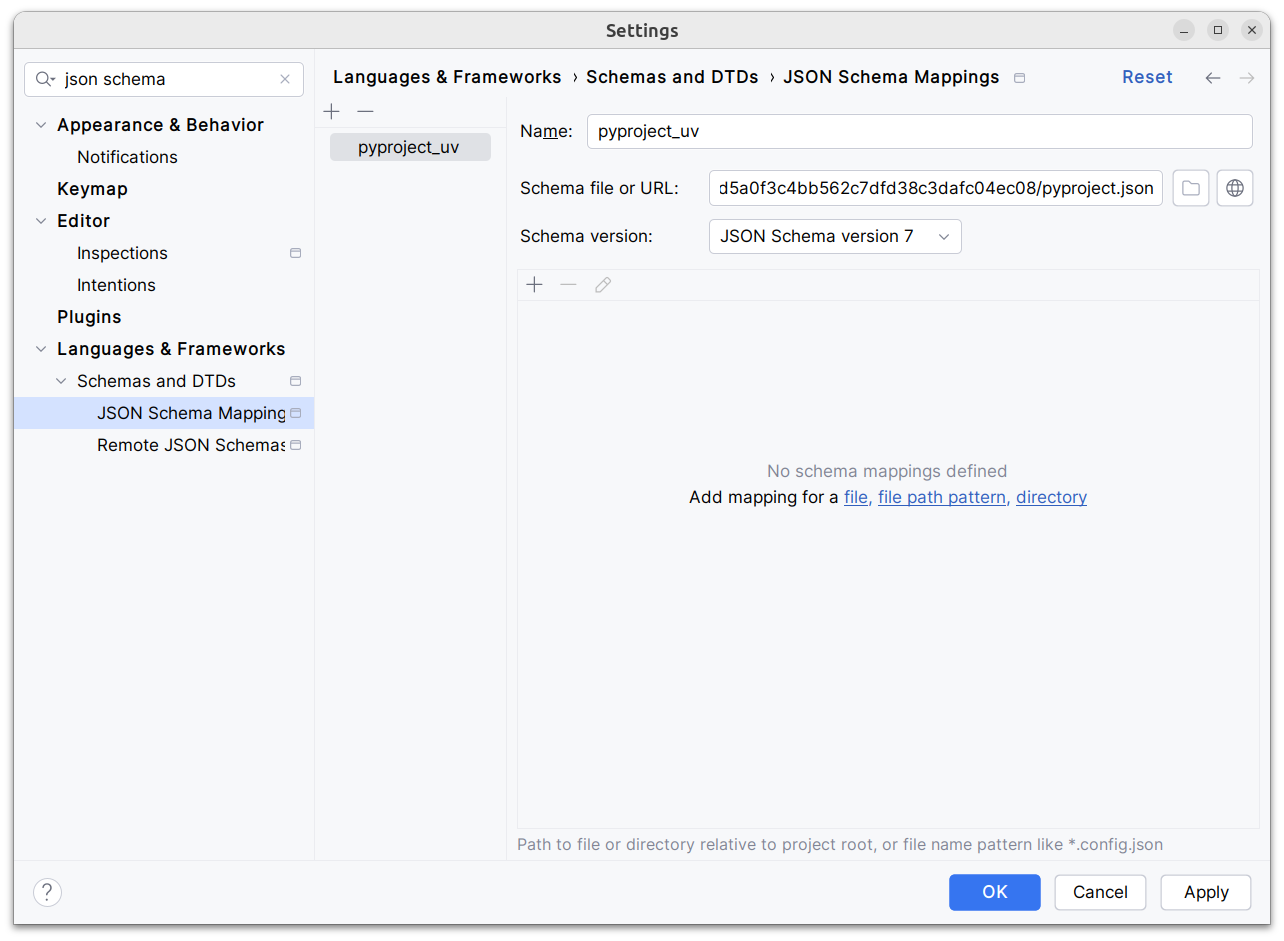
[dove.webm](https://github.com/astral-sh/uv/assets/6826232/c293c272-c80b-459d-8c95-8c46a8d198a1)
Another split out from https://github.com/astral-sh/uv/pull/3263. This
abstracts the copy&pasted check whether an installed distribution
satisfies a requirement used by both plan.rs and site_packages.rs into a
shared module. It's less useful here than with the new requirement but
helps with reducing https://github.com/astral-sh/uv/pull/3263 diff size.
Previously, a noop `uv pip install` would only show "Audited {}
package(s)" but no details, not even with `-vv`. Now it debug logs which
requirements were met and it also debug logs which requirement was
missing to trigger the full routine, allowing it investigate caching
behaviour.

First `uv pip install -v jupyter`:

```
DEBUG At least one requirement is not satisfied: jupyter
```

Second `uv pip install -v jupyter`:

```
DEBUG Found a virtualenv named .venv at: /home/konsti/projects/uv-main/.venv
DEBUG Cached interpreter info for Python 3.12.1, skipping probing: .venv/bin/python
DEBUG Using Python 3.12.1 environment at .venv/bin/python
DEBUG Trying to lock if free: .venv/.lock
DEBUG Requirement satisfied: anyio
DEBUG Requirement satisfied: anyio>=3.1.0
DEBUG Requirement satisfied: argon2-cffi-bindings
DEBUG Requirement satisfied: argon2-cffi>=21.1
DEBUG Requirement satisfied: arrow>=0.15.0
DEBUG Requirement satisfied: asttokens>=2.1.0
DEBUG Requirement satisfied: async-lru>=1.0.0
DEBUG Requirement satisfied: attrs>=22.2.0
DEBUG Requirement satisfied: babel>=2.10
...
DEBUG Requirement satisfied: webencodings
DEBUG Requirement satisfied: webencodings>=0.4
DEBUG Requirement satisfied: websocket-client>=1.7
DEBUG Requirement satisfied: widgetsnbextension~=4.0.10
DEBUG All editables satisfied:
Audited 1 package in 12ms
```

This will clash with the `tool.uv.sources` PR, i'll rebase it on top.
Previously, we got `pypi_types::DirectUrl` (the pypa spec
direct_url.json format) and `distribution_types::DirectUrl` (an enum of
all the url types we support). This lead me to confusion, so i'm
renaming the latter one to the more appropriate `ParsedUrl`.
## Summary
This PR enables `--require-hashes` with unnamed requirements. The key
change is that `PackageId` becomes `VersionId` (since it refers to a
package at a specific version), and the new `PackageId` consists of
_either_ a package name _or_ a URL. The hashes are keyed by `PackageId`,
so we can generate the `RequiredHashes` before we have names for all
packages, and enforce them throughout.
Closes#2979.
## Summary

Similar to `Revision`, we now store IDs in the `Archive` entires rather
than absolute paths. This makes the cache robust to moves, etc.

Closes https://github.com/astral-sh/uv/issues/2908.
## Summary

This PR formalizes some of the concepts we use in the cache for
"pointers to things".

In the wheel cache, we have files like
`annotated_types-0.6.0-py3-none-any.http`. This represents an unzipped
wheel, cached alongside an HTTP caching policy. We now have a struct for
this to encapsulate the logic: `HttpArchivePointer`.

Similarly, we have files like `annotated_types-0.6.0-py3-none-any.rev`.
This represents an unzipped local wheel, alongside with a timestamp. We
now have a struct for this to encapsulate the logic:
`LocalArchivePointer`.

We have similar structs for source distributions too.
## Summary
This PR enables hash generation for URL requirements when the user
provides `--generate-hashes` to `pip compile`. While we include the
hashes from the registry already, today, we omit hashes for URLs.
To power hash generation, we introduce a `HashPolicy` abstraction:
```rust
#[derive(Debug, Clone, Copy, PartialEq, Eq)]
pub enum HashPolicy<'a> {
/// No hash policy is specified.
None,
/// Hashes should be generated (specifically, a SHA-256 hash), but not validated.
Generate,
/// Hashes should be validated against a pre-defined list of hashes. If necessary, hashes should
/// be generated so as to ensure that the archive is valid.
Validate(&'a [HashDigest]),
}
```
All of the methods on the distribution database now accept this policy,
instead of accepting `&'a [HashDigest]`.
Closes#2378.
## Summary
This PR adds support for hash-checking mode in `pip install` and `pip
sync`. It's a large change, both in terms of the size of the diff and
the modifications in behavior, but it's also one that's hard to merge in
pieces (at least, with any test coverage) since it needs to work
end-to-end to be useful and testable.
Here are some of the most important highlights:
- We store hashes in the cache. Where we previously stored pointers to
unzipped wheels in the `archives` directory, we now store pointers with
a set of known hashes. So every pointer to an unzipped wheel also
includes its known hashes.
- By default, we don't compute any hashes. If the user runs with
`--require-hashes`, and the cache doesn't contain those hashes, we
invalidate the cache, redownload the wheel, and compute the hashes as we
go. For users that don't run with `--require-hashes`, there will be no
change in performance. For users that _do_, the only change will be if
they don't run with `--generate-hashes` -- then they may see some
repeated work between resolution and installation, if they use `pip
compile` then `pip sync`.
- Many of the distribution types now include a `hashes` field, like
`CachedDist` and `LocalWheel`.
- Our behavior is similar to pip, in that we enforce hashes when pulling
any remote distributions, and when pulling from our own cache. Like pip,
though, we _don't_ enforce hashes if a distribution is _already_
installed.
- Hash validity is enforced in a few different places:
1. During resolution, we enforce hash validity based on the hashes
reported by the registry. If we need to access a source distribution,
though, we then enforce hash validity at that point too, prior to
running any untrusted code. (This is enforced in the distribution
database.)
2. In the install plan, we _only_ add cached distributions that have
matching hashes. If a cached distribution is missing any hashes, or the
hashes don't match, we don't return them from the install plan.
3. In the downloader, we _only_ return distributions with matching
hashes.
4. The final combination of "things we install" are: (1) the wheels from
the cache, and (2) the downloaded wheels. So this ensures that we never
install any mismatching distributions.
- Like pip, if `--require-hashes` is provided, we require that _all_
distributions are pinned with either `==` or a direct URL. We also
require that _all_ distributions have hashes.
There are a few notable TODOs:
- We don't support hash-checking mode for unnamed requirements. These
should be _somewhat_ rare, though? Since `pip compile` never outputs
unnamed requirements. I can fix this, it's just some additional work.
- We don't automatically enable `--require-hashes` with a hash exists in
the requirements file. We require `--require-hashes`.
Closes#474.
## Test Plan
I'd like to add some tests for registries that report incorrect hashes,
but otherwise: `cargo test`
Needed to prevent circular dependencies in my toolchain work (#2931). I
think this is probably a reasonable change as we move towards persistent
configuration too?

Unfortunately `BuildIsolation` needs to be in `uv-types` to avoid
circular dependencies still. We might be able to resolve that in the
future.
Originally a regression test for #2779 but we found out that there's
some weird behavior where different `anyio` versions were preferred
based on the platform.
Addresses panic introduced in #2596 and reported in
https://github.com/astral-sh/uv/issues/2763#issuecomment-2030674936

When there are multiple versions of a package available, we remove the
existing packages before installing the resolved version to "fix" the
environment. We must remove all of the package versions and reinstall
because removing _any_ of the package versions could break the others.
Since reinstalls require a pull from the remote, this broke a contract
between the resolver and the planner which must always agree on which
packages should come from the remote. This further demonstrates that we
should be constructing the install plan with more concrete knowledge
from the resolver (i.e. `ResolvedDist` instead of `Requirement`) to
avoid having to manually ensure logic matches.

## Test plan

Fails on `main` with panic succeeds on branch

```
uv venv --seed
source .venv/bin/activate
pip install anyio==3.7.0 --ignore-installed
pip install anyio==4.0.0 --ignore-installed
cargo run -- pip install anyio black -v
```
## Summary

We can access cache from `BuildContext`. This mirrors
`SourceDistCachedBuilder`, which doesn't accept `Cache` as an argument
and always accesses it through `BuildContext`.
Previously, we did not consider installed distributions as candidates
while performing resolution. Here, we update the resolver to use
installed distributions that satisfy requirements instead of pulling new
distributions from the registry.

The implementation details are as follows:

- We now provide `SitePackages` to the `CandidateSelector`
- If an installed distribution satisfies the requirement, we prefer it
over remote distributions
- We do not want to allow installed distributions in some cases, i.e.,
upgrade and reinstall
- We address this by introducing an `Exclusions` type which tracks
installed packages to ignore during selection
- There's a new `ResolvedDist` wrapper with `Installed(InstalledDist)`
and `Installable(Dist)` variants
- This lets us pass already installed distributions throughout the
resolver

The user-facing behavior is thoroughly covered in the tests, but
briefly:

- Installing a package that depends on an already-installed package
prefers the local version over the index
- Installing a package with a name that matches an already-installed URL
package does not reinstall from the index
- Reinstalling (--reinstall) a package by name _will_ pull from the
index even if an already-installed URL package is present
- To reinstall the URL package, you must specify the URL in the request

Closes https://github.com/astral-sh/uv/issues/1661

Addresses:

- https://github.com/astral-sh/uv/issues/1476
- https://github.com/astral-sh/uv/issues/1856
- https://github.com/astral-sh/uv/issues/2093
- https://github.com/astral-sh/uv/issues/2282
- https://github.com/astral-sh/uv/issues/2383
- https://github.com/astral-sh/uv/issues/2560

## Test plan

- [x] Reproduction at `charlesnicholson/uv-pep420-bug` passes
- [x] Unit test for editable package
([#1476](https://github.com/astral-sh/uv/issues/1476))
- [x] Unit test for previously installed package with empty registry
- [x] Unit test for local non-editable package
- [x] Unit test for new version available locally but not in registry
([#2093](https://github.com/astral-sh/uv/issues/2093))
- ~[ ] Unit test for wheel not available in registry but already
installed locally
([#2282](https://github.com/astral-sh/uv/issues/2282))~ (seems
complicated and not worthwhile)
- [x] Unit test for install from URL dependency then with matching
version ([#2383](https://github.com/astral-sh/uv/issues/2383))
- [x] Unit test for install of new package that depends on installed
package does not change version
([#2560](https://github.com/astral-sh/uv/issues/2560))
- [x] Unit test that `pip compile` does _not_ consider installed
packages
## Summary

This looks like a big change but it really isn't. Rather, I just split
`get_or_build_wheel` into separate `get_wheel` and `build_wheel` methods
internally, which made `get_or_build_wheel_metadata` capable of _not_
relying on `Tags`, which in turn makes it easier for us to use the
`DistributionDatabase` in various places without having it coupled to an
interpreter or environment (something we already did for
`SourceDistributionBuilder`).
This is driving me a little crazy and is becoming a larger problem in
#2596 where I need to move more types (like `Upgrade` and `Reinstall`)
into this crate. Anything that's shared across our core resolver,
install, and build crates needs to be defined in this crate to avoid
cyclic dependencies. We've outgrown it being a single file with some
shared traits.

There are no behavioral changes here.
## Summary

This PR enables the source distribution database to be used with unnamed
requirements (i.e., URLs without a package name). The (significant)
upside here is that we can now use PEP 517 hooks to resolve unnamed
requirement metadata _and_ reuse any computation in the cache.

The changes to `crates/uv-distribution/src/source/mod.rs` are quite
extensive, but mostly mechanical. The core idea is that we introduce a
new `BuildableSource` abstraction, which can either be a distribution,
or an unnamed URL:

```rust
/// A reference to a source that can be built into a built distribution.
///
/// This can either be a distribution (e.g., a package on a registry) or a direct URL.
///
/// Distributions can _also_ point to URLs in lieu of a registry; however, the primary distinction
/// here is that a distribution will always include a package name, while a URL will not.
#[derive(Debug, Clone, Copy)]
pub enum BuildableSource<'a> {
    Dist(&'a SourceDist),
    Url(SourceUrl<'a>),
}
```

All the methods on the source distribution database now accept
`BuildableSource`. `BuildableSource` has a `name()` method, but it
returns `Option<&PackageName>`, and everything is required to work with
and without a package name.

The main drawback of this approach (which isn't a terrible one) is that
we can no longer include the package name in the cache. (We do continue
to use the package name for registry-based distributions, since those
always have a name.). The package name was included in the cache route
for two reasons: (1) it's nice for debugging; and (2) we use it to power
`uv cache clean flask`, to identify the entries that are relevant for
Flask.

To solve this, I changed the `uv cache clean` code to look one level
deeper. So, when we want to determine whether to remove the cache entry
for a given URL, we now look into the directory to see if there are any
wheels that match the package name. This isn't as nice, but it does work
(and we have test coverage for it -- all passing).

I also considered removing the package name from the cache routes for
non-registry _wheels_, for consistency... But, it would require a cache
bump, and it didn't feel important enough to merit that.
## Summary

This PR ensures that if a package is already satisfied by the current
environment, we don't bother resolving the named requirement.

Part of: https://github.com/astral-sh/uv/issues/313.

## Test Plan

- `cargo run pip install ./scripts/editable-installs/black_editable`
- `cargo run pip install black --verbose`
## Summary

We would like to be able to configure the installer-name so that other
tools can co-exist with `uv`. In `pixi` we would like to use `pixi-uv`
as the installer name, for example, to be able to distinguish them from
packages installed by pure `uv`.
## Summary

This PR changes our user-facing representation for paths to use relative
paths, when the path is within the current working directory. This
mirrors what we do in Ruff. (If the path is _outside_ the current
working directory, we print an absolute path.)

Before:

```shell
❯ uv venv .venv2
Using Python 3.12.2 interpreter at: /Users/crmarsh/workspace/uv/.venv/bin/python3
Creating virtualenv at: .venv2
Activate with: source .venv2/bin/activate
```

After:

```shell
❯ cargo run venv .venv2
    Finished dev [unoptimized + debuginfo] target(s) in 0.15s
     Running `target/debug/uv venv .venv2`
Using Python 3.12.2 interpreter at: .venv/bin/python3
Creating virtualenv at: .venv2
Activate with: source .venv2/bin/activate
```

Note that we still want to use the existing `.simplified_display()`
anywhere that the path is being simplified, but _still_ intended for
machine consumption (e.g., when passing to `.current_dir()`).
## Summary

In reality, there's no such thing as the `site-packages` directory for a
given virtualenv. Rather, Python defines both `purelib` and `platlib`,
where the former is for pure-Python packages and the latter is for
packages that contain native code. These are almost always set to the
same thing... but they don't _have_ to be, and in fact of Fedora they
are not.

This PR changes the `site_packages` method to return an iterator of
directories.

Closes https://github.com/astral-sh/uv/issues/2527.
## Summary

This may be required elsewhere, but all the traces in that issue are
related to persisting the temporary directory to our persistent cache,
so lets start there.

See: https://github.com/astral-sh/uv/issues/1491.
Since Python 3.7, deterministic pycs are possible (see [PEP
552](https://peps.python.org/pep-0552/))
To select the bytecode invalidation mode explicitly by env var:

    PYC_INVALIDATION_MODE=UNCHECKED_HASH uv pip install --compile ...

Valid values are TIMESTAMP (default), CHECKED_HASH, and UNCHECKED_HASH.
The latter options are useful for reproducible builds.

---------

Co-authored-by: konstin <konstin@mailbox.org>
## Summary

PyPI now supports Metadata 2.2, which means distributions with Metadata
2.2-compliant metadata will start to appear. The upside is that if a
source distribution includes a `PKG-INFO` file with (1) a metadata
version of 2.2 or greater, and (2) no dynamic fields (at least, of the
fields we rely on), we can read the metadata from the `PKG-INFO` file
directly rather than running _any_ of the PEP 517 build hooks.

Closes https://github.com/astral-sh/uv/issues/2009.
Sometimes, the first time we read from the stdout of the bytecode
compiler python subprocess, we get an empty string back (no newline). If
we try to write to stdin, it will often be a broken pipe (#2245). After
we got an empty string the first time, we will get the same empty string
if we read a line again.
The details of this behavior are mysterious to me, but it seems that it
can be identified by the first empty string. We check by inserting
starting with a `Ready` message on the Python side. When we encounter
the broken state, we discard the interpreter and try again.
We have to introduce a third timeout check for the interpreter launch
itself.
Minimized test script:
```bash
#!/usr/bin/env bash
set -euo pipefail
while true; do
date --iso-8601=seconds # Progress indicator
rm -rf testenv
target/profiling/uv venv testenv -q --python 3.12
VIRTUAL_ENV=$PWD/testenv target/profiling/uv pip install -q --compile wheel==0.42.0
done
```
Run as
```
cargo build --profile profiling && bash compile_bug.sh
```
Fixes#2245
Follow-up to #2086: Don't use timeouts for the entire workers, but only
for the section that's about communicating with the (potentially broken)
`python` subprocess. I've also raised the timeout to 60s.
Add a `--compile` option to `pip install` and `pip sync`.
I chose to implement this as a separate pass over the entire venv. If we
wanted to compile during installation, we'd have to make sure that
writing is exclusive, to avoid concurrent processes writing broken
`.pyc` files. Additionally, this ensures that the entire site-packages
are bytecode compiled, even if there are packages that aren't from this
`uv` invocation. The disadvantage is that we do not update RECORD and
rely on this comment from [PEP 491](https://peps.python.org/pep-0491/):
> Uninstallers should be smart enough to remove .pyc even if it is not
mentioned in RECORD.
If this is a problem we can change it to run during installation and
write RECORD entries.
Internally, this is implemented as an async work-stealing subprocess
worker pool. The producer is a directory traversal over site-packages,
sending each `.py` file to a bounded async FIFO queue/channel. Each
worker has a long-running python process. It pops the queue to get a
single path (or exists if the channel is closed), then sends it to
stdin, waits until it's informed that the compilation is done through a
line on stdout, and repeat. This is fast, e.g. installing `jupyter
plotly` on Python 3.12 it processes 15876 files in 319ms with 32 threads
(vs. 3.8s with a single core). The python processes internally calls
`compileall.compile_file`, the same as pip.
Like pip, we ignore and silence all compilation errors
(https://github.com/astral-sh/uv/issues/1559). There is a 10s timeout to
handle the case when the workers got stuck. For the reviewers, please
check if i missed any spots where we could deadlock, this is the hardest
part of this PR.
I've added `uv-dev compile <dir>` and `uv-dev clear-compile <dir>`
commands, mainly for my own benchmarking. I don't want to expose them in
`uv`, they almost certainly not the correct workflow and we don't want
to support them.
Fixes#1788Closes#1559Closes#1928
## Summary

Ensures that local dependencies function similarly to editables, in that
if they're `uv pip install`ed, we invalidate them.

Closes https://github.com/astral-sh/uv/issues/1651.
## Summary

Internal-only refactor to consolidate multiple codepaths we have for
checking whether a cached or installed entry is up-to-date with a local
requirement.
## Summary

`PythonPlatform` only exists to format paths to directories within
virtual environments based on a root and an OS, so it's now
`VirtualenvLayout`.

`Virtualenv` is now used for non-virtual environment Pythons, so it's
now `PythonEnvironment`.
## Summary

This PR adds a `--python` flag that allows users to provide a specific
Python interpreter into which `uv` should install packages. This would
replace the `VIRTUAL_ENV=` workaround that folks have been using to
install into arbitrary, system environments, while _also_ actually being
correct for installing into non-virtual environments, where the bin and
site-packages paths can differ.

The approach taken here is to use `sysconfig.get_paths()` to get the
correct paths from the interpreter, and then use those for determining
the `bin` and `site-packages` directories, rather than constructing them
based on hard-coded expectations for each platform.

Closes https://github.com/astral-sh/uv/issues/1396.

Closes https://github.com/astral-sh/uv/issues/1779.

Closes https://github.com/astral-sh/uv/issues/1988.

## Test Plan

- Verified that, on my Windows machine, I was able to install `requests`
into a global environment with: `cargo run pip install requests --python
'C:\\Users\\crmarsh\\AppData\\Local\\Programs\\Python\\Python3.12\\python.exe`,
then `python` and `import requests`.
- Verified that, on macOS, I was able to install `requests` into a
global environment installed via Homebrew with: `cargo run pip install
requests --python $(which python3.8)`.
 Charlie Marsh